 |
 |
 |
 |
 |
 |
 |
 |
 |
 |
 |
 |
|
|
|
|
|
|
|
|
|
|
|
|
|
|
|
|
|
|
|
|
|
|
|
|
| Houses |
|
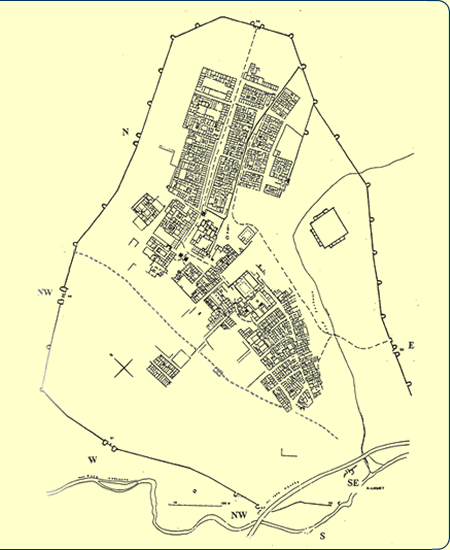
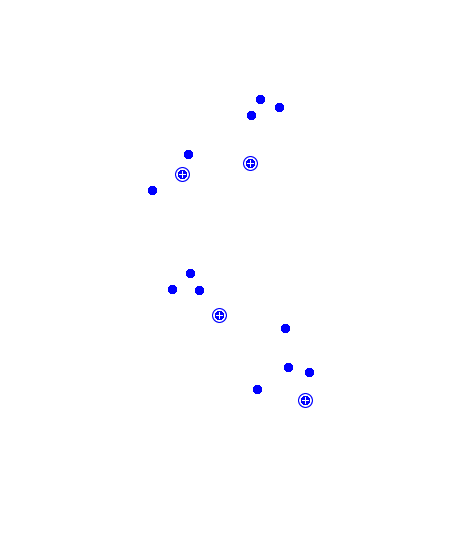
At this level, you can show all the houses to see how they relate. If you click the map you will zoom in. Zoom in closer using the small map in the bottom left and you can click on individual houses. |
| Medieval Town |
|
Some time after the departure of the Roman administration from the
southern half Mauretania Tingitana the population of Volubilis seems
to have become concentrated on the eastern slope of the hill. This may
have been due to the failure of the aqueduct, so that the inhabitants
of the town would have depended on the Oued Khomane and wells for their
water supply. Around the fifth century a new city wall was built, separating
this area from the old city center. The walls enclose 18 ha. within
the old Roman town. Outside were cemeteries, particularly in the area
of the Arch of Triumph. Christian funerary inscriptions from this cemetery
show that some of the population still spoke Latin, and used dates based
on the foundation of the Roman province. According to medieval tradition,
the conquering Oqba Ibn Nafi, having made peace with the Romano-Berber
Julian at Tangiers, continued on to Walila, where he fought Berber tribes.
There was an Abbasid ribat, and coins were struck with the name Walila.
It is thus likely that when Idris arrived at the site in 788, a Romano-Berber
population still occupied the site. Abbasid control of the city was
hardly secure, for Idris was welcomed there by the tribe of the Awraba
and its leader. However, we can be reasonably certain that the site
was expanded and reorganized as his capital. The little baths excavated
by Rosenberger and El Khayari clearly form part of this expansion. Their
lack of any distinctive ‘Ummayad’ traits, and their apparent
derivation from the baths of Roman North Africa, again imply a substantial
continuity in the local population. |
| Bakers and Millers at Volubilis |
|
Baking and milling flour was one of the principle activities for which we have evidence at Volubiulis. This daily activity linked the city to its countryside, rich in cereal cultivation. By the 1980's sixteen baker's shops had been found in the city, along with around twenty mills and querns found scattered around the city. The grinding elements themselves present a variety of types and forms. They were cut from a volcanic stone found in the Middle Atlas, outside of the zone of Roman control. The best-preserved installations are that of the Pre-Roman Forum, the shop near the House of the Bronze Bust, those of the House of Flavius Germanus, and those of Insula 10.
|
|
Bibliography
Luquet(A), 'Blé et meunerie à Volubilis', B.A.M, T.VI, 1966, p.p301-316. |
| Rampart |
|
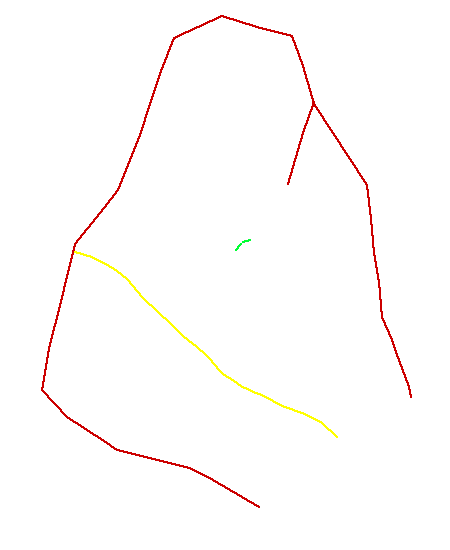
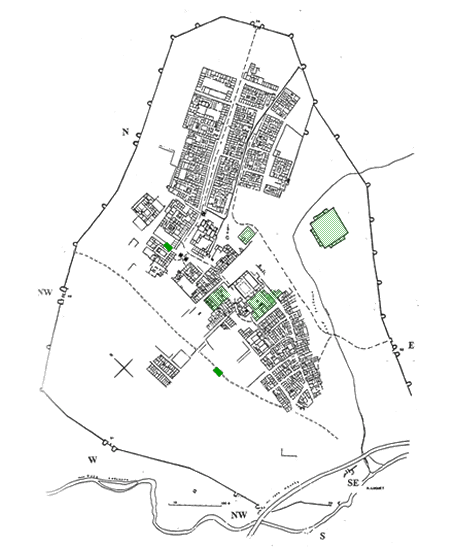
The Mauretanian rampart (GREEN) is seen for a short stretch of 77m. under the tumulus, and in its immediate vicinity. The visible sections are composed of foundations in cut stone, with an elevation in mud brick. The collapse of this upper section is clearly visible in the section cut into the tumulus by previous excavations. |
|
(RED) An irregular polygon 2,613 metres long, the Roman rampart encloses 40 hectares. Built of rubble masonry faced with ashlars, it had 6 main gates flanked by towers and 24 other towers. Its construction dates from 168/169 C.E., during the reign of the emperor Marcus Aurelius, who also built the city walls of Rome |
|
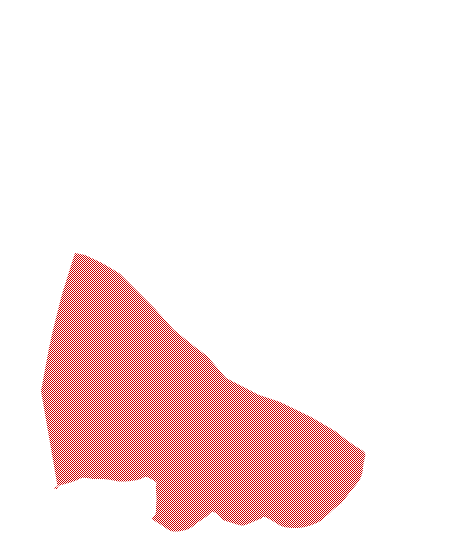
(YELLOW) Oriented north-south, this rampart was constructed with blocks reused from earlier constructions. It delimited the later town, now reduced to the southeast slope of the hillside, separating it from the early Roman town center which was now occupied by cemeteries. A recent excavation has demonstrated that it was built in the fifth or sixth century A.D |
| The Aqueduct |
|
An aqueduct leading from a large spring to the northeast brought water for the town. It was reconstructed a number of times, but its earliest phase may be dated to around 60-80 C.E. Water from secondary channels fed the larger houses, the baths and
the public fountains. |
| Temples |
|
The religious stuctures of Volubilis are spread across the site and the chronological periods of its occupation. Some of these structures testify to a continuous evolution from the Mauretanian period onward. Six temples have been found: temple B, known as the temple of Saturn, temple C to the east of the tumulus, temple D in the monumental center, the twin temples of the western quarter and the Punic temple to the east of the Capitolium, and the Capitolium itself. These structures show very different plans, and bear witness to a wide
variety of inspirations, as well as to the individual styles of the
local artisan tradition. |
| Oil Presses |
|
The presses of Volubilis use the same principle as the majority of the presses in the Roman Mediterranean. After crushing, the olive paste was loaded into woven baskets. These were then stacked in the centre of the press, and the prelum was cranked down on top of the stack with the aid of the pulley. The oil that ran out of the baskets was channelled into the decantation basin. Here water was added, and the oil that floated to the surface was ladled directly into amphorae. The decantation basins were periodically emptied through run off channels. We can see some development in the technology at Volubilis: the counterweights for the prelum seem to have shifted from a rectangular block to a cylindrical form around the beginning of the second century C.E. so as to increase their efficiency. The uniform technology of the Volubilis oil complexes seems to testify
to the cultural coherence of the community. There number, however, is
striking, as is their integration into most of the largest houses. Oil
was clearly one of the major sources of wealth for the town. The production
of transport amphorae from the end of the second century B.C.E. demonstrates
the early growth of the oil trade. |
| Public Baths |
|
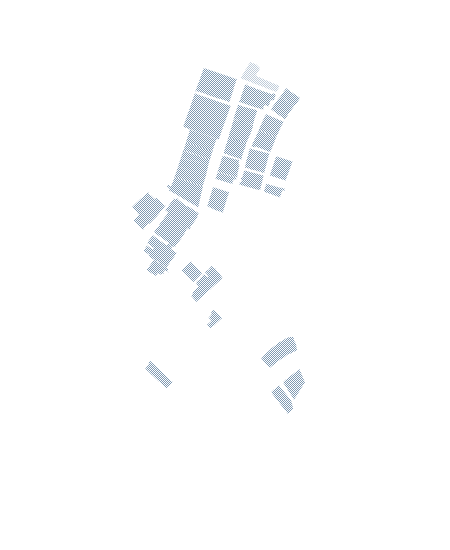
Baths were an essential component of the ancient urban landscape. Along with the forum and the shops they were part and parcel of the social life of the town. The baths all followed a typical plan. One entered through a vestibule, then proceeded to the changing room (apodytermium). Through the cold room (frigidarium) one passed into a warm room (tepidarium) and through it into the hot rooms (caldaria, laconica). Here one remained until a sweat had been worked up, which was scraped off with an instrument called a striglium. The bather then returned to the cold room, to rince himself off in the plunge baths and to relax. A palestra served for exercise and sports, which would take place before the baths.
|
| Mosaics |
|
At this level, you can show all the mosaics to see how they relate. Zoom in closer using the small map in the bottom left. |
| Public Buildings |
|
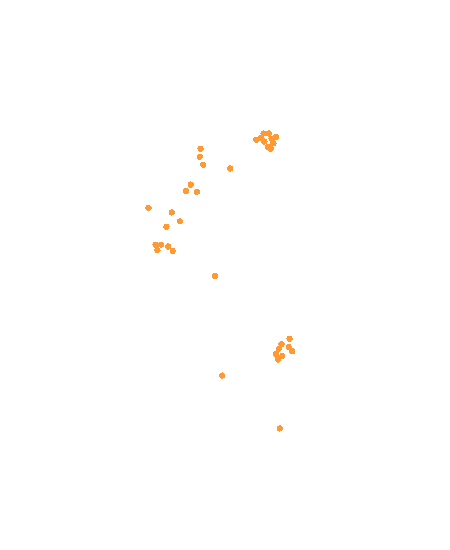
At this level, you can show all the public buildings to see how they relate. If you click the map you will zoom in. Zoom in closer using the small map in the bottom left and you can click on individual buildings. |




 |
 |
 |
 |
 |